Civics Education
Civic Participation and Engagement in Virginia


While such institutional blocks to civic engagement and political participation are no longer so readily apparent, “there is persistent evidence that citizens are not much interested in participation” (Bowman and Kearney, 2000, p. 65). Low voter turnout in national, state, and local elections and weak attendance at public meetings are frequently reported. However, research tells us that civic and political engagement strengthens the civic culture of communities and regions, and that a strong civic culture as reflected in an engaged, active, and aware citizenry, is something that politicians and local leaders ignore at their peril. Non-participation and civic inaction can easily be ignored by politicians and community leaders; however, a consistently active and engaged citizenry requires and demands that politicians and local leaders pay attention to public needs and issues which, in turn, lays the foundation for the expectation and creation of strong, transparent, efficient, and responsive state and local government that supports the common good (Bellamy 2008; Rice & Sumberg, 1997). Civic education, as the Virginia League of Women Voters recognized in 1920, is vital for the creation of an active citizenry. And as Bellamy (2008) reminds us:
By and large, patterns of civic engagement or disengagement are created at an early age…So, the more young people can be informed about and interested in democratic politics prior to their first opportunity to vote, the better. Civic engagement is also likely to be improved by attempts to devolve power to more local communities. Shared values and common purposes are likely to be stronger in such settings, and with them the willingness to engage in collective programs. (p. 121)
Interested in exploring various definitions of citizen, citizenship, and civic engagement? Then click here.

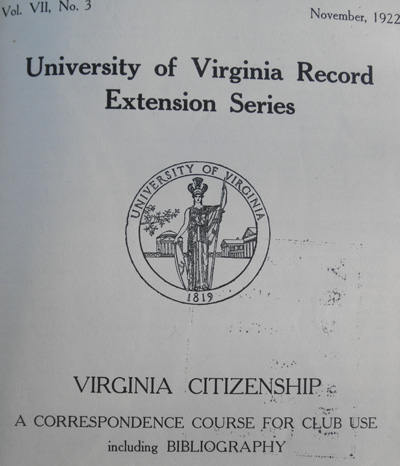
Virginia citizenship book, 1922
Virginia citizenship book - 1922
Courtesy of David Hicks
Probably the most common responsibility of an active citizenry is to exercise the right to vote. The act of voting should never be seen as a simple and isolated act that has little consequence; rather the power of one’s vote comes with the realization that it is the “…most effective mechanism for [citizens] to promote their collective interests and encourage their political rulers to pursue the public’s good rather than their own.…” (Bellamy 2008, p. 3).

Interested in reviewing a “rough and ready” guide to voting in Virginia? Then click here.


Voting as a form of civic engagement represents one of many ways citizens move beyond private self interest toward a commitment to involvement and participation in public life to build stronger, more cohesive communities – demonstrating a commitment to advancing the public good or common good (Levine, 2011). Possessing clear knowledge of the pathways to both political office and civic participation is a vital first step to being an informed and engaged citizen.

In this video Dr. Craig Brians, associate professor of political science at Virginia Tech, describes pathways to political office and political participation in Virginia.


< Previous | Next >